


Blog, Montessori
Montessori boxes and toys by child's age in Qatar: a practical guide
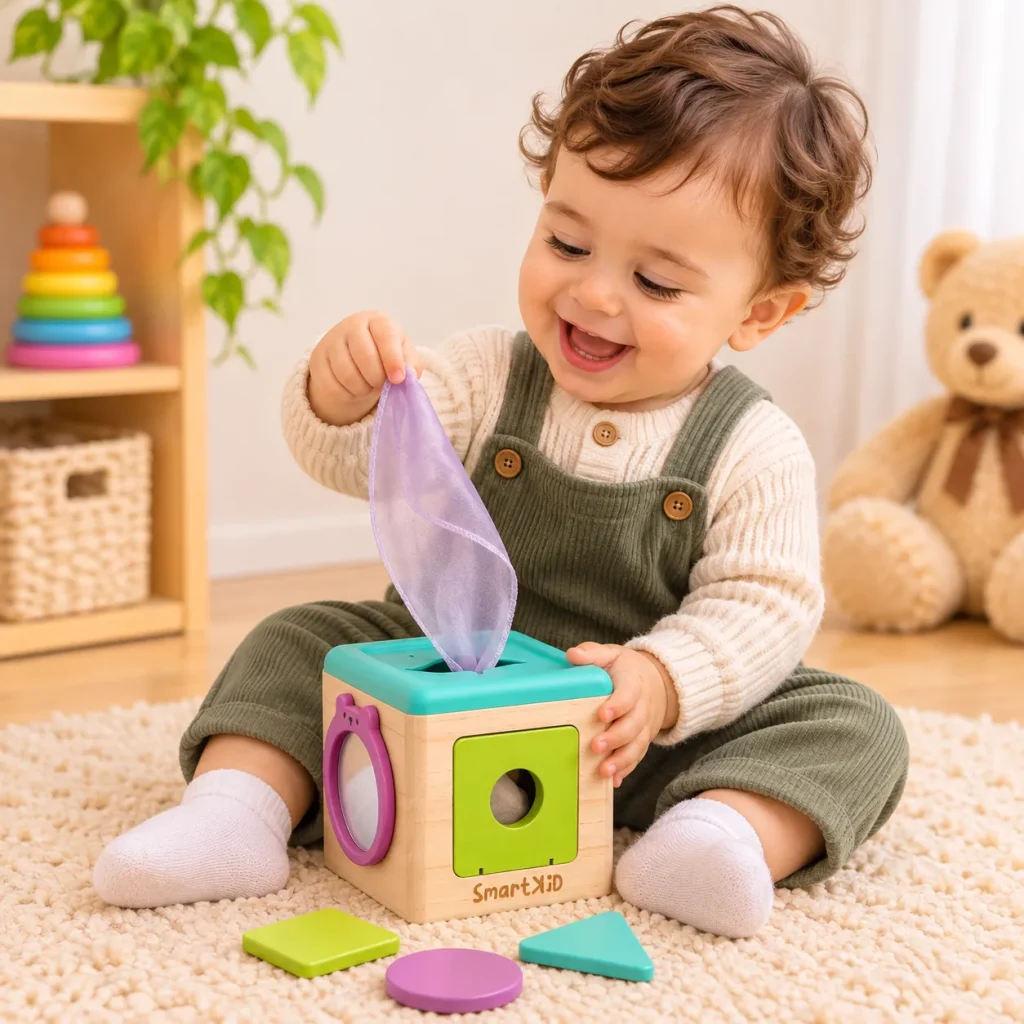
Choosing a suitable Montessori toy starts from your child's current skill, not just the number printed on the box. Age gives a useful starting point, but daily observation is what shows whether your child is ready for grasping, putting in and taking out, or matching and sorting. This guide helps you choose Montessori activities and toy boxes by age in Qatar, showing when household items are enough and when a ready-made toy is more practical.
The idea isn't buying the largest number of toys, but offering one clear activity at the right time, then leaving room for your child to repeat and try in their own way. Two children of the same age may need two different degrees of difficulty; that is completely normal.
What does Montessori mean in practice?
In home practice, the Montessori approach means the task is clear and your child can take part with their hands: picking up, placing, matching, opening, closing, arranging or carrying. Ideally the toy offers one main challenge instead of a set of effects, lights and sounds that do the work for them.
Not every tool has to carry the name “Montessori”. A safe bowl and a large spoon, or pieces of cloth of different textures, may offer an excellent experience when they suit your child's age and are used under adult supervision. What matters is the simplicity of the goal, allowing repetition, respecting your child's rhythm, and preparing a safe space where they can work with gradual independence.
A quick table: age, skill and the suitable activity
| Approximate age | The most prominent skill | Examples of suitable activities | What we watch |
|---|---|---|---|
| 0–6 months | Visual tracking and early grasp | High-contrast cards, safe cloth, a large, light rattle | Head control, eye tracking, opening the palm |
| 6–9 months | Passing an object between the hands, and sitting | A large soft ball, large rings, a safe discovery basket | Deliberate reaching and gripping with both hands |
| 9–12 months | Cause and effect, and putting in | Dropping a large piece, taking out of a bowl, opening a simple drawer | Repetition and searching for the hidden object |
| 12–18 months | Simple matching and fine movement | Large pegs, fitting two pieces, carrying large objects | Precision while keeping the attempt enjoyable |
| 18–24 months | Solving a problem in one or two steps | Sorting two colours, matching two shapes, opening and closing, simple arranging | Asking for help instead of throwing the activity straight away |
| 24 months and up | Classification, sequencing and longer concentration | Suitable puzzles, multiple sorting, large tongs, practical-life activities | The ability to complete a short task and redo it |
The ages are approximate and are not a developmental test. If you have an ongoing observation about movement, communication or responsiveness, discuss it with your child's doctor or a qualified developmental specialist.
From birth to 6 months: the senses and calm movement
In the first months an infant doesn't need to “solve a toy”. They need clear sight, a gentle voice, safe floor time to move, and large things they can touch without risk. You can use contrast cards, a safe mirror for infants, or a piece of cloth with a clear texture. Place the activity at a distance your child can see, then let them follow with their eyes or reach out without fast, continuous movement.
Safety comes first here: no beads, no small loose pieces, no long cords, and nothing that could cover the nose and mouth. See also the guide to Montessori activities from birth to 6 months for more specific ideas for this stage.
From 6 to 9 months: gripping, passing and exploring
As sitting and hand control improve, a child begins passing things from one hand to the other, banging, turning objects, and following what moves. A small basket with three large, safe household items is sometimes better than a crowded box: a silicone ring, a cloth ball, and a wide wooden spoon, for example. Offer only two or three items so your child can notice the differences.
The details of choosing and progressing are in the guide to Montessori toys for 6–9 months. If your baby puts everything in their mouth, that is an expected part of exploring; so the materials must withstand saliva and cleaning and have no small parts that come off.
From 9 to 12 months: putting in, and cause and effect
Many children at this stage enjoy putting something inside a container and then searching for it, pushing a big ball, or opening and closing a drawer. This is where understanding begins that an action leads to a result. Choose a large piece that's easy to grip and a clear opening, and start with one slow attempt in front of your child, then leave the turn to them.
You can continue with Montessori activities for 9–12 months. Don't raise the difficulty by adding many colours and sizes at once; your child's success at a simple step, with a few calm attempts, matters more than finishing the task quickly.
From 12 to 18 months: independence and practical life
After the first year, daily-life activities become attractive: putting clothes in a basket, wiping a drop of water with a cloth, carrying large blocks, or putting a large peg in a clear place. Make the tools hand-sized, offer a small amount, and expect some mess. The aim isn't perfect execution but movement coordination and understanding sequence.
For suitable progression see the Montessori guide for 12 to 18 months. If your child needs full help every time, simplify the task: make the opening bigger, use fewer pieces, or remove one step.
From 18 to 24 months: matching, sorting and problem solving
At this age many children can follow short instructions, choose a piece from two, and begin sorting and matching. Offer an activity with a clear beginning and end, such as putting two red pieces in one bowl and two blue ones in another, or matching two different lids with their boxes.
Don't expect long sitting. Five to ten minutes can be a successful session. You'll find eight practical ideas and signs for easing the difficulty in the guide to Montessori toys and activities for 18–24 months.
After the age of two: classification and simple planning
After 24 months the number of options can be increased gradually: three colours instead of two, a puzzle of a few pieces, a two-step sequence, or carrying pieces with large tongs. Choose the toy according to the skill you want to support, not because it looks advanced. A child still learning to post shapes will benefit more from a clear posting activity than a complicated puzzle.
If you're looking for a ready-made toy, use the guide to buying Montessori toys after age two. If you want free ideas from household items, see Montessori activities at home for two-year-olds. Keeping the two guides separate gives you a clearer decision: buy a durable tool, or set up a quick home activity.
How do you choose a toy by skill?
- Grip and finger strength: large pieces that are easy to hold, then gradually smaller handles.
- Hand–eye coordination: putting a piece into a clear opening, or building a short tower.
- Visual discrimination: matching two shapes or two colours before adding other choices.
- Problem solving: a box with a drawer or lid, or a puzzle with few pieces and a visual guide.
- Language: naming real objects and clear pictures during play without turning the session into a test.
- Independence: an activity your child can start and finish with limited adult involvement.
A practical rule: if your child succeeds the first time without concentrating, the activity may be too easy. And if they fail after two or three attempts and begin to cry or throw, they probably need it simplified. The good level is one that lets them progress after a little experimenting.
When are household items enough? And when is a ready-made toy useful?
Household items are enough when the task is simple, the materials can be fixed safely, and you have time to supervise and set up. Plastic bowls, large spoons, socks for matching, and a cardboard box with a wide opening can offer an excellent learning experience.
A ready-made toy helps when you need graded sizes and consistent precision, want an activity that's easy to reuse, or are looking for a complete gift. Quality, durability and ease of cleaning are important factors, but the name “Montessori” alone doesn't guarantee a product is suitable.
A safety check before buying or playing
- Read the recommended age and the company's instructions, then compare it with your child's actual behaviour.
- Check for small pieces, magnets, batteries, cords, edges, and any peeling paint.
- Make sure the pieces don't detach when pulled or bitten, especially for a child who puts things in their mouth.
- Use the toy on a stable surface, with an adult close by.
- Check the wood and joints regularly, and stop use if a break or crack appears.
- Don't treat the word “wooden” or “natural” as a safety guarantee; the design and condition matter more.
Options available now at Smart Kid
According to the live product pages at the time this guide was updated, four products are available in the Montessori toy boxes category: Discover Box with five sensory and interactive toys, suitable from 6 months, theCylinder Drop Box suitable from 6 months, and theSkills Box with five toys for assembling, matching and pulling, suitable from 12 months, and theMusical Ball Box – Smart Kid suitable from 12 months. There are no published reviews yet for the Cylinder Drop Box or the Musical Ball Box, so we did not use experiences from other products to evaluate them. To compare the four boxes, read How to choose a toy box suitable for your child's age.
The Cylinder Drop Box may suit a child who can sit or play in a steady position, reaches for large pieces and enjoys repetition. It may not be the right choice yet if the child still cannot grasp the cylinders, or if you prefer a simple home activity that does the same job. Always check the price, stock and age on the product page before ordering, because this information may change.
A quick decision checklist before buying
- What single skill do I want to support now?
- Can my child start the required movement, even with slight help?
- Are the pieces suitable for their age and oral behaviour?
- Can the difficulty be eased or increased?
- Do I have a safe household item that achieves the same goal?
- Will the toy be used more than once and in more than one way?
- Are the space, ease of storage and cleaning suitable for the home?
How to present a Montessori activity in a short session
- Set up the space: choose a quiet surface and place the activity alone in front of your child, away from the TV and moving toys.
- Show the movement slowly: do one step without a long explanation. A clear movement is easier than a string of spoken instructions.
- Leave the turn to your child: wait before stepping in. They may need time to work out the direction of the piece or to repeat their mistake.
- Help as little as possible: steady the bowl or bring the piece closer rather than finishing the task for them.
- End the session calmly: when they lose interest or start using the pieces in an unsafe way, pack the activity away and say: “We'll try again later”.
A session doesn't need tens of minutes. In the early stages, three minutes of focused participation may be enough. Repetition over days matters more than one long session in which your child has to carry on.
How do we increase difficulty without buying a new toy?
After mastering the activity, change only one variable. Add a second piece, or make the opening slightly smaller, or ask for matching two colours, or move the activity from the hand to age-appropriate large tongs. Don't change the size, colour and number of steps at the same time, because you won't know which part became hard.
And to reduce difficulty, do the opposite: reduce the options, use clearer visual contrast, fix the bowl, or go back to a bigger piece. You can also divide the activity; for example your child chooses the piece while the adult holds the box first, then your child takes over both steps when ready.
Organising and rotating toys at home
Put a limited number of toys on a low shelf, each activity in its own basket or tray. This makes the start and end clear and makes it easier for your child to return the tools. Watch for a week: what do they return to? What do they ignore? What causes frustration? Keep the useful, store the too-easy temporarily, and bring back the hard activity after simplifying it.
Rotation doesn't mean buying new. Alternate between a fine-motor activity, a language activity, a simple puzzle, a book, and a practical-life tool. This balance gives your child varied experiences without visual clutter or repeated cost.
Frequently asked questions
Must I buy a whole box for every age stage?
No. A good learning environment can be built with a few activities rotated every week or two. Buy only when the toy adds an experience that's hard to provide with household items, or when you need a ready-made, durable gift.
Should I choose a higher age so the product lasts longer?
Not necessarily. A much harder toy may stay neglected. Choose a level at which your child achieves partial success now, with a little room to grow, and stick to the stated safety limits.
How many toys do I display at once?
Start with three to five clear options in a low, organised place, and reduce the number if your child moves between them without concentration. Storing the rest of the toys and rotating them is often more useful than displaying them all.
What do I do if my child throws the pieces?
First check their need for movement and the difficulty of the activity. Show how to use it calmly once and reduce the pieces. If the throwing continues or a risk appears, end the activity and try it at another time.
In summary: start with the child, then choose the tool
The best Montessori toy isn't the most expensive or the most complicated; it's the safe activity that meets your child's current skill and encourages independent attempts. Use age as a compass, watch their movement and interest, and offer one challenge at a time. If you decide to buy, you can browse the Montessori toys category currently available and review each product's live details before deciding.

Comments are closed.