

Blog, Interactive Activity Books
The best ways to teach your child Arabic letters before school
Every mother reaches the stage of asking: when do I start teaching my child the Arabic letters, and how do I make it fun instead of dry, boring memorisation? The answer starts with understanding that learning letters is not only memorising a shape and a drawing, but linking shape, sound and movement together.
When do you actually start?
Ages 3 to 4 are suitable for recognising letter shapes and sounds in a preliminary, unpressured way, while ages 4 to 6 are the best time for actual writing practice, when your child's fine hand muscles are more ready to hold and control the pen.
3 principles that make letter learning stick in your child's memory
- Link the sound before the shape: let your child hear the letter's sound and repeat it aloud before trying to draw it, because hearing always comes before writing in natural learning.
- Link the letter to a word they know: the letter “ب” with the word “بابا” (dad) or “بطة” (duck) is much stronger than an abstract letter with no context.
- Spaced repetition, not cramming: 10 minutes a day on one or two letters is better than a whole hour once a week.
A practical tool: the Horoofi book
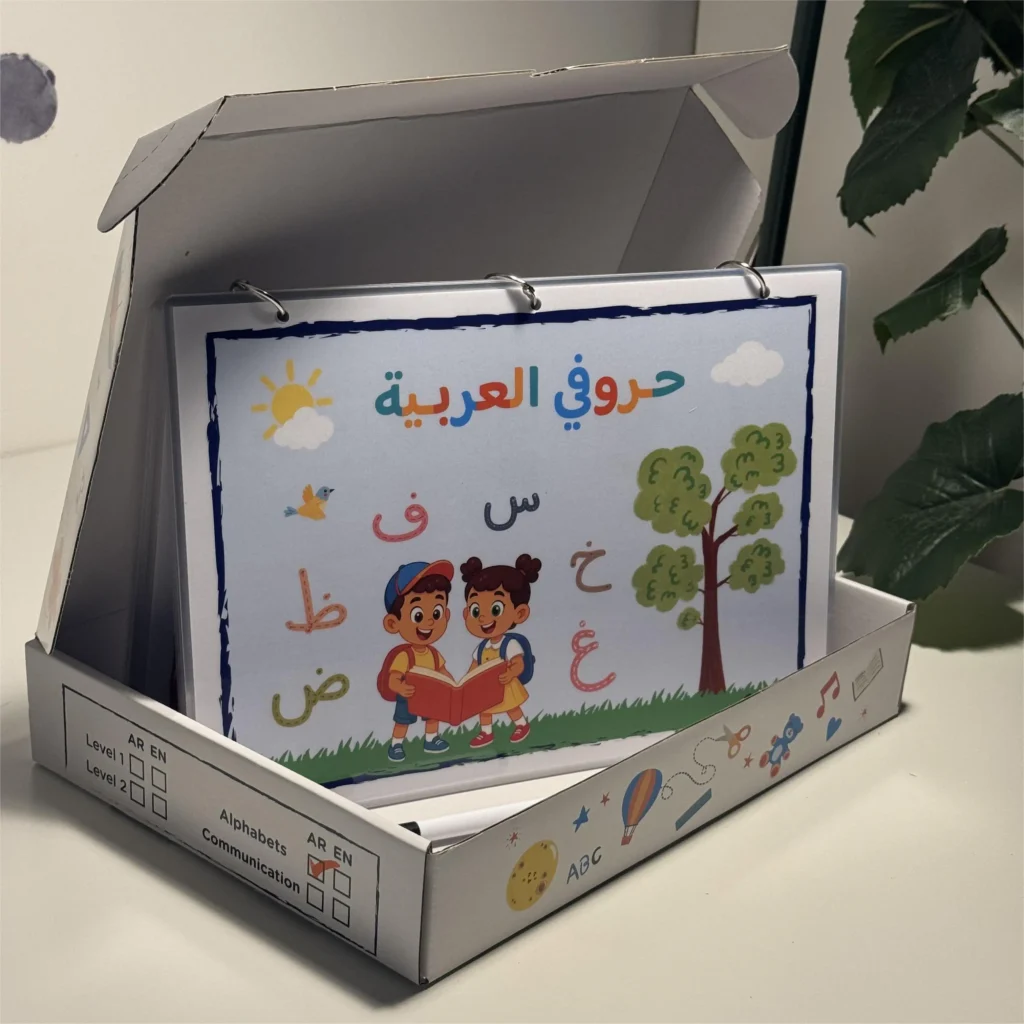
Smart Kid's Horoofi book is designed around these same principles: it covers the full alphabet from Alif to Yaa, and each letter has a practice page combining recognition of its shape and sound, familiar words with pictures, and space for repetition. The pages are laminated and wipe-clean, with a free marker pen, so your child can repeat the same letter dozens of times without printing new sheets each time.
Signs that your child is ready to actually start
If your child holds the pen with relative steadiness, is interested in watching the letters and words around them, and tries to imitate writing even with unintelligible scribbles — these are good signs of readiness. If they haven't appeared yet, there's no need to rush; phonetic recognition of letters can begin early, even before actual readiness for writing.
Frequently asked questions
When do I start teaching my child the Arabic letters?
You can start phonetic recognition of letters from about age 3, while actual writing practice suits ages 4 to 6 more, when the fine hand muscles are ready.
What's the difference between memorising letters and understanding them?
Memorising means only remembering the order or the shape, while understanding means linking the letter to its sound and to real words your child uses daily — and that's what makes learning last.
Is the Horoofi book suitable for a child who has never held a pen?
Yes, the book begins with simple recognition activities before moving on to actual writing, and can be used gradually according to your child's readiness.
You may also like
- A guide to interactive activity books for children in Qatar
- Browse the interactive activity books category
- Hand-strengthening activities before writing
For more hands-on practice, read short activities for teaching letters at home.

Comments are closed.