


Blog, Montessori
Discover Box: toys and activities for a child from 6 months
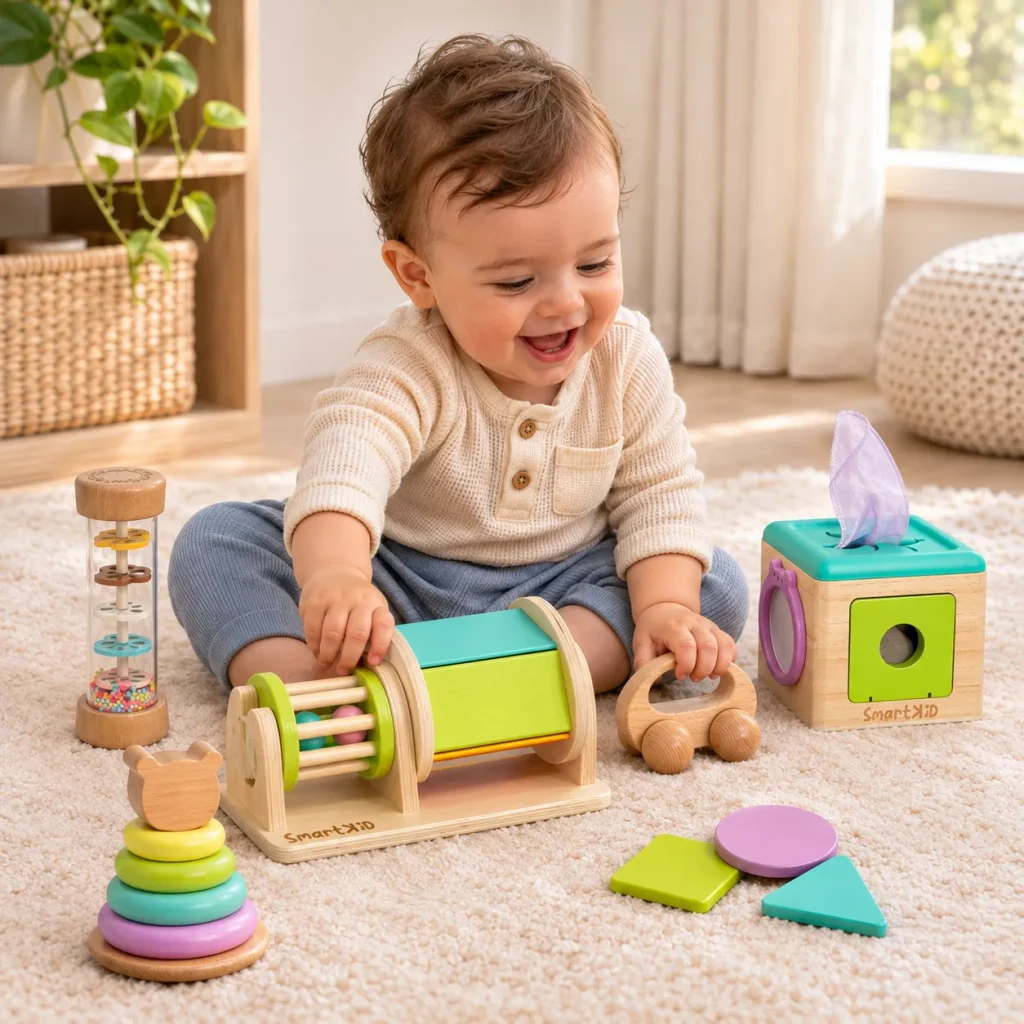
When a child reaches about six months, play becomes more active: they reach for what they see, grasp and turn objects, notice sounds and colors, and follow movement. Discover Box from Smart Kid is a set of five sensory and interactive toys inspired by Montessori principles, with a stated age of 6 months and above. In this article we explain what is inside it and how to present the toys one at a time at home.
What happens in play at this stage?
Children differ in their pace of development, but many of them at this age explore with their senses: they touch, pull, shake and watch what happens after their movement. This means the suitable toy is often a simple one that responds to their hand movement with a clear result: a sound, a spin, or something that drops or moves.
There is no need for a long session. A few minutes of focused play with one toy is better than putting all the pieces in front of them at once. For more about this stage, see Montessori toys for 6-9 months.
What is inside the Discover Box?
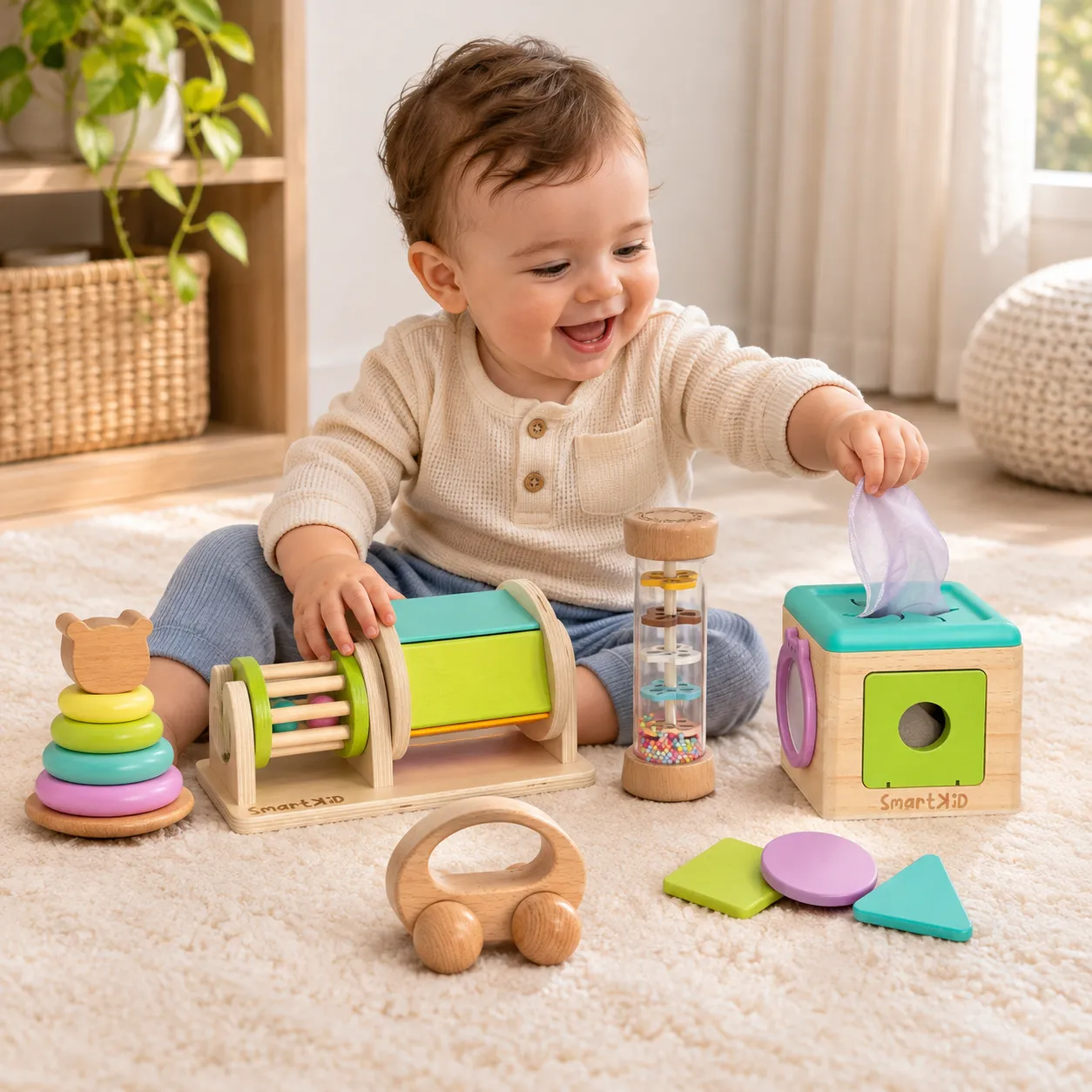
According to the current product page, the box includes five toys:
1. Sensory Pull & Shape Box
A wooden box with sensory fabrics that are pulled from the top opening and put back, and colorful geometric pieces that can be explored and inserted into the matching openings. At first you can pull the fabric slowly in front of your child, then let them try pulling it themselves.
2. Spinning Drum & Rattle
A cylinder with colorful rotating panels, plus a rattle part with wooden rods and colorful beads. The child can move the parts, follow their rotation and hear the sound that accompanies the movement.
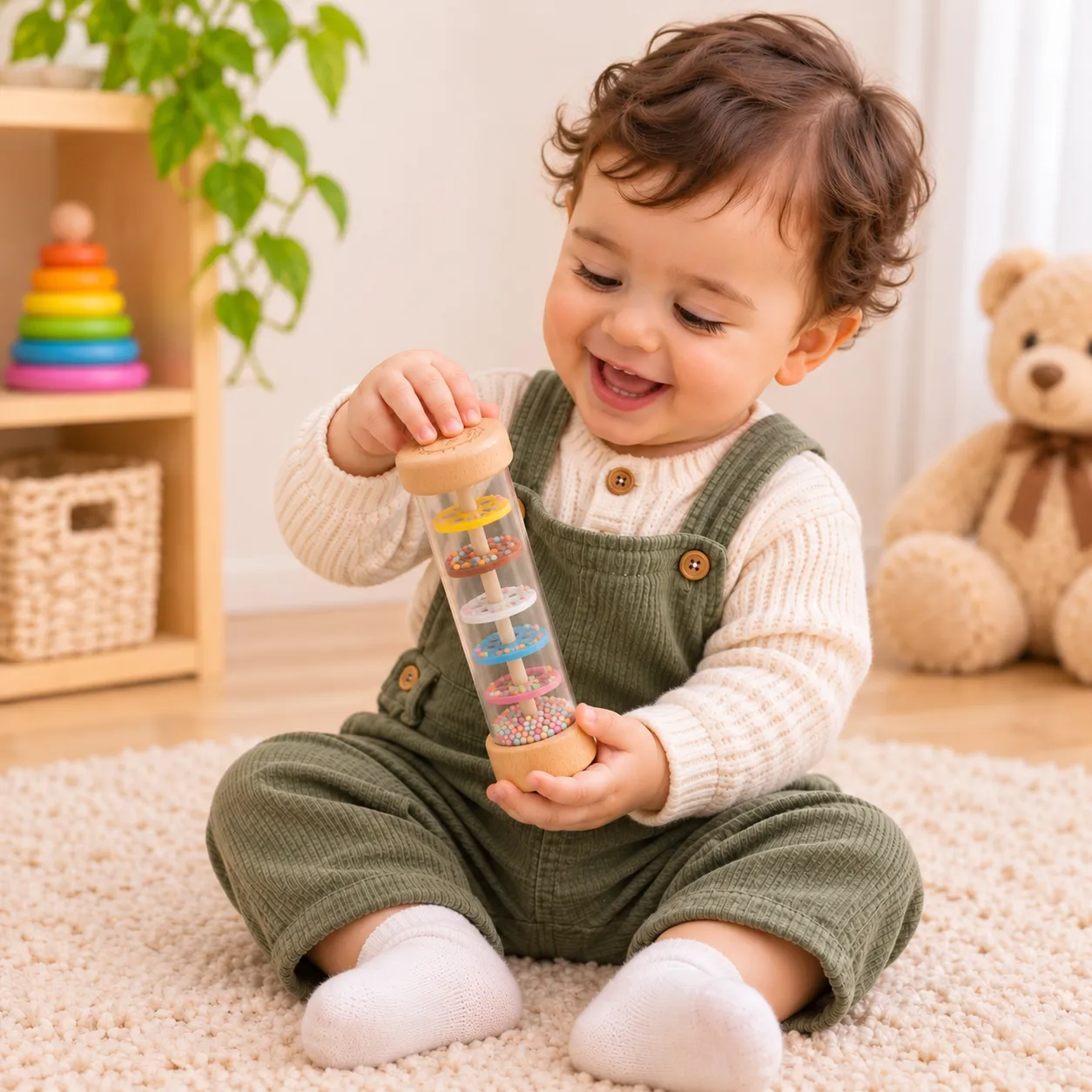
3. Sensory Rainmaker
A transparent tube with two wooden ends and small colorful granules inside. When the tube is turned over, the granules fall gradually with a gentle sound, and the child follows them with their eyes. Try turning it slowly near your child and let them follow.
4. Rainbow Ring Stacker
A base and colorful rings graduated in size with a wooden piece on top. The child can hold the rings, then try inserting them onto the post, taking them off and rearranging them.
5. Wooden Push Car
A small wooden car with an easy-to-hold handle and moving wheels. The child pushes it along the floor and follows its movement.
You can find each toy's description on the Discover Boxpage, while here we focus on how to use it.
How do you present the toys one at a time?
- Start with one toy. Choose the toy that seems closest to your child's interest today, and do not open the rest of the box.
- Show the movement once. Pull the fabric, spin the cylinder or turn the rain stick slowly, then stop.
- Let them try. They may hold the toy differently from what you expected, and that is part of exploring.
- End before they get bored. If they look away or start to fuss, close the session calmly.
- Put the toy back in the box and present another one at a different time.
There is no mandatory order for the toys, as the product page's FAQ explains: choose according to the child's interest and readiness for movement and interaction.
Playing with the box at home
- Spread a rug or mat in a quiet place away from the TV.
- Sit at your child's level so they can see your face and the toy together.
- Keep unused toys out of sight so the space does not get crowded.
- Stay beside the child throughout play, as the toys are used under adult supervision.
Rotating toys according to interest
Your child may love the rain stick for a week and then lean toward the car. That's fine. Keep two toys within reach each week, return the rest to the box, then swap. This habit keeps the toys new in their eyes without buying more, and gives them a chance to return to the same toy once they are better able to handle it. You will find general ideas for organizing the space in the home learning corner.
When might it be too early or too late?
If your child is younger than 6 months, the box's stated age has not started yet, and you can wait. And if they have passed the stage and handle the toys easily, more challenging toys may catch their attention, such as those in the Skills Box from 12 months. And to compare all the boxes, see How to choose a toy box suitable for your child's age.
A typical five-minute play session
It does not need a complicated program. Here is a simple example for an ordinary day:
- Spread the rug and seat your child comfortably, then put only the rain stick in front of them.
- Turn it slowly once and let them follow the granules as they fall.
- If they reach out, let them hold it, and watch how they turn or shake it.
- After a few minutes, put it back in the box and gently tell them playtime is over.
- Tomorrow try another toy, such as the car or the rotating cylinder.
What do you notice in each toy?
- The pull box: Do they hold the fabric with one hand or both? Do they notice it disappearing and appearing?
- The cylinder and rattle: Do they follow the rotation with their eyes? Do they move the parts themselves?
- The rain stick: Do they follow the granules? Are they interested in the sound?
- The ring stacker: Do they hold the ring and move it? Do they try to insert it?
- The car: Do they push it? Do they follow its movement?
These observations do not measure your child; they help you see what attracts them today so you can start with it.
Common mistakes
- Taking out all five toys at once.
- Constantly correcting how they play; let them explore first.
- Prolonging the session after they look bored.
- Leaving the child alone with the toys.
An example of weekly rotation
| Week | Toys within reach | Notes |
|---|---|---|
| First | Rain stick + car | Start simple and watch their interest |
| Second | Rotating cylinder + pull box | Put the first ones back in the box |
| Third | Ring stacker + a favorite toy | Make the favorite the basis of the session |
This table is only a suggestion; change it according to your child's interest.
Frequently asked questions
Is the Discover Box suitable for 6 months?
Yes, the age stated on the product page is 6 months and above, used under adult supervision.
How many toys should I give my child in one session?
One or two toys is usually enough, then switch according to their interest. Presenting all the toys together may distract them.
Do the toys need to be introduced in a specific order?
No. The toy can be chosen according to the child's interest and readiness for movement and interaction.
Can the box be used at home?
Yes, it is suitable for play at home on a rug or in a quiet space, and the toys are used under adult supervision.
Summary
Discovery at this stage starts from simple things: a fabric being pulled, granules falling, a car moving. You can look at the Discover Box to see the toys inside it and compare its contents with your child's current stage. And if you want wider ideas for choosing toys between 6 and 12 months, read Educational toys from 6 to 12 months.
