

Blog
10 home activities for children with simple materials + a weekly plan
You can do useful home activities with children using things you already have at home: socks, spoons, boxes, paper, pencils and pictures. An activity doesn't need long preparation; what matters is that it has one clear goal, a short time, and a way to make it simpler or harder depending on how your child responds.
In this guide you'll find ten activities for matching, sorting, colours, numbers, vocabulary, feelings and fine hand skills, then a simple weekly schedule. The ages mentioned are approximate, and safe tools and suitable supervision should be chosen for each child.
Before starting: choose the right activity for the day
Start by noticing three things: your child's energy, the available time, and whether they want to sit or move. On a very active day, choose a sorting or a search in the room. In a quiet time, try a picture story or tracing a line. A short activity that ends comfortably is better than a long plan that turns into pressure.
- Present only one activity or two options.
- Use large, safe tools, especially with young children.
- Explain in a short sentence and give one model.
- Allow your child a different way as long as it's safe and serves the idea.
- Stop at tiredness, frustration or loss of interest.
1. Matching colours with things at home
Approximate age: 2–5 years
Materials: three safe objects in different colours, and three sheets of paper or paper plates in the same colours
Time: 5 minutes
Skill: observation, matching and vocabulary
How: put the objects in the middle of the space and ask your child to place each one on the matching colour. Say the colour's name when they choose it, then ask them about something else in the room in the same colour.
Make it easier: start with two contrasting colours and one object per colour. Make it harder: add similar shades, or ask your child to describe the object by its colour and use, such as “a blue spoon”.
2. Sorting socks
Approximate age: 2–6 years
Materials: clean socks of different sizes and colours
Time: 5–10 minutes
Skill: sorting, comparing and independence in the home routine
How: mix up four or six socks and ask your child to match each pair. After matching, they can be sorted by size or colour. Don't make speed the goal; ask: “What made you know these two are a pair?”.
This activity suits involving your child in a real household task. And for little ones, avoid big piles that may confuse them. Two pairs are enough at first.
3. Number hunting and matching quantity
Approximate age: 3–6 years
Materials: hand-written number cards, and large, safe blocks or plastic spoons
Time: 7 minutes
Skill: linking the number symbol to a quantity, and counting one by one
How: choose a number card from 1 to 5, then ask your child to gather the same number of objects. Touch each object as you count so they understand that each spoken number matches one object.
Make it easier: start with the numbers 1 and 2. Make it harder: ask for two ways to make a number; for example, two red objects and one blue one for the number 3. Don't move on to writing the number if your child is still working out quantity.
4. Tracing lines before writing
Approximate age: 3–6 years, depending on readiness
Materials: large paper, a thick crayon, and tape to hold the paper down
Time: 5 minutes
Skill: movement control and hand–eye coordination
How: draw a wide straight line, then a curved one. Your child traces it with a finger first, then with the crayon if they want. You can draw a road for a small car instead of presenting it as a writing exercise.
Don't hold your child's hand to force it along the path. Offer a model, let them try, and enlarge the line if they often go outside it. The aim is gradual control, not an exact copy the first time.
5. Moving things between two bowls
Approximate age: 2–5 years
Materials: two stable bowls, and large pieces that can't be swallowed, or cloth balls
Time: 5–8 minutes
Skill: fine hand movement, coordination and focus
How: your child moves the pieces by hand from one bowl to the other. When the activity becomes easy, a suitable large spoon can be used. Put a towel under the two bowls if the items might fall.
Safety: don't use beads, grains or small pieces with a child who might put things in their mouth. Supervision is always necessary, and no sharp or breakable tools should be used.
6. The touch-and-describe bag
Approximate age: 3–7 years
Materials: a cloth bag, and three safe, familiar objects such as a ball large enough not to be swallowed, a spoon and a brush
Time: 7 minutes
Skill: vocabulary, description and sensory observation
How: your child puts their hand in the bag without looking, touches an object and describes it: soft or rough? Long or short? After guessing, they take it out, name it and say what it's used for.
If their vocabulary is limited, offer two choices: “Is it soft or rough?”. And for an older child, ask for three adjectives or a full sentence. The activity can be done in Arabic or English, but don't translate every word immediately if that interrupts the play.
7. A story from three pictures
Approximate age: 3–8 years
Materials: three pictures from an old magazine, simple drawings or non-sensitive family photos
Time: 10 minutes
Skill: sequencing, expression and imagination
How: lay the pictures out in random order, and let your child choose an order and tell what happened first, then next, then at the end. There is no single correct order if the story makes sense to them.
Make it easier: tell the beginning of the story and let them choose the ending. Make it harder: add a small problem and a solution, or ask them to change the ending.
8. Faces of feelings and situations
Approximate age: 3–7 years
Materials: paper and pens, or a safe mirror
Time: 5–10 minutes
Skill: naming feelings and linking them to an everyday situation
How: draw four simple faces: happy, sad, angry and scared. Mention a situation such as losing a toy or meeting a friend, and let your child choose the face that might fit. Ask: “What could help in this situation?”.
There is not always a single feeling answer, and don't use the activity to assess your child or force them to talk. If they don't want to share their feeling, they can talk about an imaginary character.
9. Complete the pattern
Approximate age: 4–7 years
Materials: large, safe lids in two colours, or blocks
Time: 5–8 minutes
Skill: observation, prediction and solving a pattern
How: lay out a simple sequence: red, blue, red, blue, then ask what the next piece is. Once they succeed, let them make a pattern for you to complete.
Make it easier: repeat only two colours. Make it harder: use three items or a pattern such as red, red, blue. Avoid small pieces with younger children.
10. The child is the teacher
Approximate age: 4–8 years
Materials: any activity your child has mastered, or a set of objects to sort
Time: 5–10 minutes
Skill: explaining, reviewing and confidence in trying
How: ask your child to explain the rule to you and give an example. Make a small deliberate mistake and ask how they'd fix it, without mockery. When they explain, you see how they understand it better than from asking “Did you get it?”.
If they don't want to speak, they can give the instructions by pointing or arranging the tools in front of you. The goal is swapping roles, not testing their ability to present.
A simple weekly activity schedule
This is a flexible model, not a programme you must complete. Choose five days or only three, and repeat the activity your child asked for. Each session can be between 5 and 15 minutes.
| Day | Activity | Tools | Main goal |
|---|---|---|---|
| Day 1 | Matching colours | Coloured items and papers | Observation and vocabulary |
| Day 2 | Sorting socks | Clean socks | Classification and practical routine |
| Day 3 | Number hunting | A card and items to count | Number and quantity |
| Day 4 | Tracing a line or moving between two bowls | Paper and pen, or two bowls | Fine hand skills |
| Day 5 | A picture story or feelings | Three pictures or drawn faces | Language and expression |
| Day 6 | Your child's choice | The favourite activity | Repetition and independence |
| Day 7 | Rest, or a story and free movement | No preparation | Balance, and not turning the week into homework |
How do you adjust the activities by age?
- 2–3 years: two options, large pieces, one-step instructions, and a shorter time.
- 4–5 years: add a “why?” question, a simple count, or a three-step sequence.
- 6–8 years: describing in a sentence, a rule the child makes up, or recording the result in drawing and writing.
These limits are approximate. If the activity causes frustration, go back to a simpler version whatever the age. And if it becomes too easy, change the way you ask instead of adding lots of tools.
What if your child refuses the activity?
Stop without lengthy negotiation. The time may not be right, the instructions unclear, or the activity harder than it looks. Offer a movement option or a story, then try on another day. Don't use a big reward to force them to sit, and don't correct every attempt.
You can refer to the guide on handling an activity session without pressure for practical phrases and steps when your child refuses or asks for help.
Organising the tools without a big corner
Put the activity materials in one basket and put them back when you finish. Don't set out ten games and books at the same time. A small space on a rug or the corner of a table is enough, and you can use the guide to setting up a simple learning corner at home if you want to organise and rotate the materials.
When do we use ready-made activities?
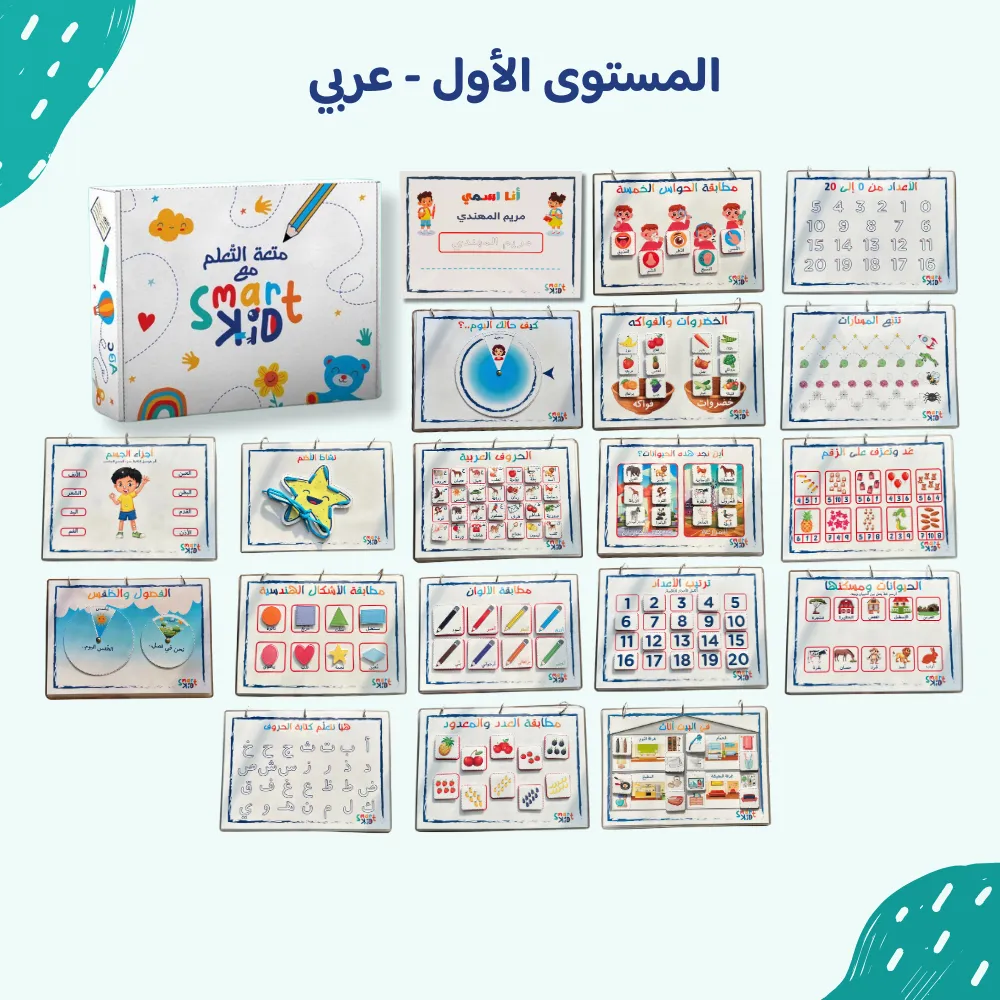
Household items are enough to start matching, sorting, counting and vocabulary. Ready-made activities may become useful when the family wants to save preparation time, or repeat tracing and matching pages, or organise multiple skills in one book. They aren't a necessity, and shouldn't replace free play, movement and stories.
Frequently asked questions
How many activities do we do in a day?
One short activity is enough. If your child asks to continue, a second, different activity can be added, but don't make completing the schedule a goal.
Do I need to print cards?
No. You can write the numbers by hand and use socks, lids and pictures you already have. Choose the simplest setup that serves the idea.
Must my child answer by speaking?
No. They can take part by pointing, matching or moving, and then language expands gradually through conversation.
How do I know the activity is suitable?
Your child understands the idea after a short model, tries, and can succeed at part of it without the time turning into a struggle.
Next step: try two free activities from this guide first. If the family finds that their child enjoys repetition and wants ready-made write-and-wipe activities, you can compare the interactive activity books and choose the right level and language. For the foundation level, the Arabic activity book for ages 2–5 offers 19 activities documented on the product page.

Pingback: Wipe-Clean Activity Book or Workbook? A Comparison of Use and Cost
Pingback: A children's learning corner at home: place, tools and organisation by age
Pingback: Montessori Activities for Two-Year-Olds at Home: Safe and Simple Ideas
Pingback: Using the Activity Book Without Pressure: What to Do When There Is Refusal or a Mistake
Pingback: English Activities for Kids at Home: A 5-Minute Routine with Examples
Pingback: Teaching Arabic Letters to Children: The Letter-of-the-Day Routine at Home