


Blog, Montessori
From Discovery to Skills: how do toys progress with your child over the first two years?
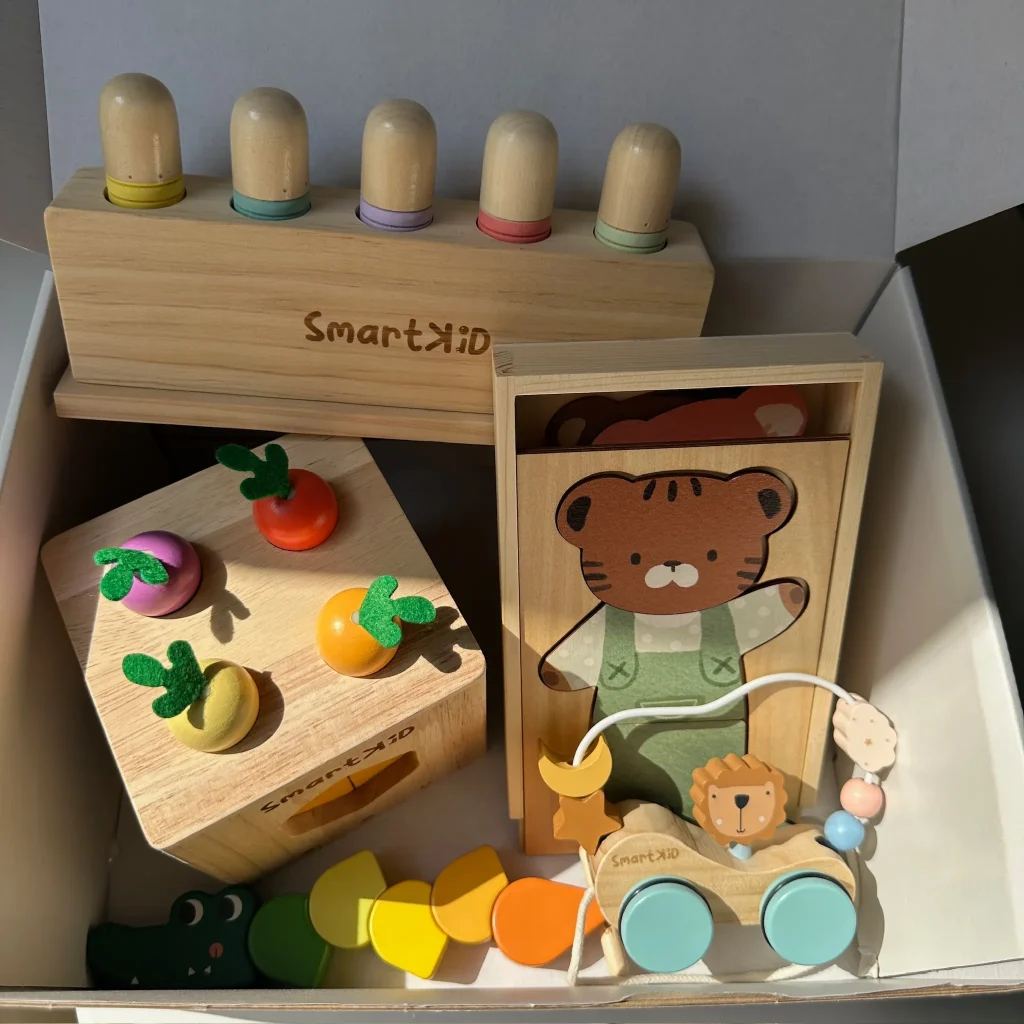
In the first two years a child's interest in play changes more than at any later stage. What occupied them in the seventh month does not necessarily occupy them in the fifteenth. So it is not enough to ask "what is the best toy?"; rather: what toy suits their interest now, and what might come next? This article explains the idea of progression in play over the first two years, and uses Smart Kid's four current boxes as practical examples.
Play progresses from exploring to trying
The picture can be simplified like this: the child often begins with sensory exploration: they touch, watch and listen. Then they start repeating the movement to see the result. Then they try to carry out an idea: inserting, matching, pulling or assembling. After that they try to complete an activity from beginning to end. These are not fixed rules, as children progress at different speeds, but it is a way that helps you choose what suits.
Four stations and examples from the boxes
Station one: exploring (around 6 months and after)
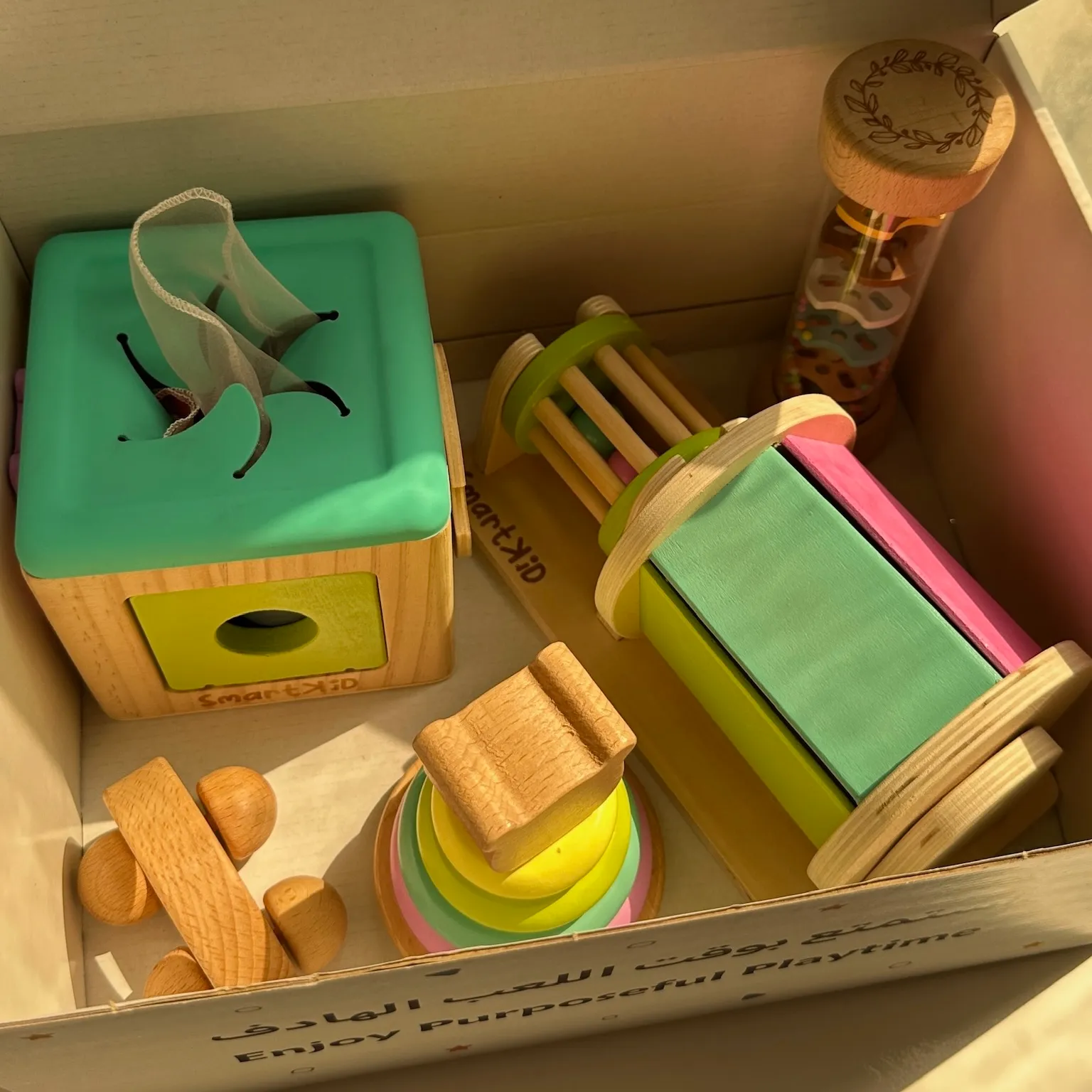
What suits this stage is what gives the child their senses: colors, sounds, textures and movement. Discover Box is an example: fabrics that are pulled, a rotating cylinder, a rain stick, a ring stacker and a push car. Its stated age is from 6 months. The details of the stage are in Montessori toys for 6-9 months.
Station two: repetition and seeing the result (around 9 months and after)
Here the child may like an activity with clear steps: grasp, drop, retrieve, repeat. Cylinder Drop Box is an example, and its stated age is also from 6 months; the child can start with it early or later according to their readiness. See also Montessori toys for 9-12 months.
Station three: trying and matching (from 12 months)
After age one many children tend toward more specific actions: pressing, inserting, matching and pulling. Skills Box is an example with its five toys, and its stated age is from 12 months. We explained how to use it in Skills Box: what does it offer a child from 12 months?.
Station four: movement and sound together (from 12 months)
Musical Ball Box – Smart Kid is a single toy that combines tapping balls and rolling them over the xylophone keys; the xylophone can be detached and used on its own, and its stated age is from 12 months. It suits those who like movement and sound, and may be a nice addition to the child's toys rather than a replacement for them.
Note that the boxes overlap in their stated ages, so they are not a strict ladder but options. To compare them in detail, see How to choose a toy box suitable for your child's age.
Why don't we show all the toys at the same time?
When all the toys are opened in front of the child, they may move from one to another without going deep into any. By contrast, a small display gives them a chance to notice differences and repeat the experience. This is what calm play environments inspired by Montessori principles are built on, and we discussed the idea in Montessori at home vs nursery.
One or two toys per session
- Choose one toy at first, and add a second only if the child stays interested.
- Keep the session short: a few minutes is sometimes enough.
- End play before they get bored, so they stay eager to come back.
- Put the toy back in its place after the session, and let the child take part as far as they can.
Rotating toys according to interest
Gather the toys in a box or basket, and leave two or three within reach. After a few days swap some of them. You will notice that a toy the child ignored may become a favorite when they return to it, because they have become better able to handle it. You will find ideas for organizing the corner in the home learning corner for children.
When do we move to a harder toy?
Do not move by age alone. Move when you see that the child has mastered the current activity easily, repeats it with no new interest, or looks for a bigger challenge. And if they still enjoy a simpler toy, let them. Real progression follows the child, not the schedule.
Choosing the product suitable for the stage
If you want to buy, start with a question: what is my child doing now? Then choose what suits that within the stated age, and check the product page. You can browse the Montessori toy boxes category to compare options. And after 18 months you can look at Montessori activities and toys for 18–24 months.
The big picture in a table
| Station | What usually occupies the child | Example from the boxes | Stated age |
|---|---|---|---|
| Exploring | Touching, pulling, listening and following | Discover Box | From 6 months |
| Repetition | Dropping, retrieving and seeing the result | Cylinder Drop Box | From 6 months |
| Trying | Pressing, inserting, matching and pulling | Skills Box | From 12 months |
| Movement and sound | Tapping, rolling and playing music | Musical Ball Box – Smart Kid | From 12 months |
The table is for illustration only. A child may enjoy a box from an earlier station after having passed it, and another may start early with a toy from a later station.
An example of a play week
- Saturday: a short session with a new toy.
- Sunday and Monday: keep the same toy and notice what they do.
- Tuesday: add a second toy if they stay interested.
- Wednesday: a quiet day with no new toys.
- Thursday: swap an old toy for a new one.
- Friday: free play with what they like.
Common mistakes in toy progression
- Jumping quickly to a harder toy: it may frustrate the child.
- Keeping a too-easy toy for a long time: if they seem bored, try a simple challenge.
- Comparing with peers: the pace of development differs.
- Buying everything at once: progression saves money and space.
Frequently asked questions
Must I buy a box for each age stage?
No. A good play environment can be built with a few toys and rotating them. Buy when a toy adds an experience that is hard to provide at home.
How do I know my child is ready for a harder toy?
When they master the current one easily and repeat it with no new interest, or seem to be looking for a bigger challenge. Watch their interest more than their age in months.
Should I show all the toys in the box at once?
It is usually better to present one or two toys, then switch according to their interest.
Is the stated age binding?
It is guidance from the manufacturer. Watch your child's abilities and the safety of the pieces, and use the toys under adult supervision.
Summary
Progression in play is a simple idea: start with what suits your child now, reduce what is displayed, and swap according to interest. You can look at the Discover Box if your child is at the beginning of exploring, or the Skills Box if they have passed one year and like trying and assembling.

Pingback: Choosing a toy box suitable for your child's age | Smart Kid